
Latte in C Minor
Bobby Calving Milks Human Kindness

Latte in C minor
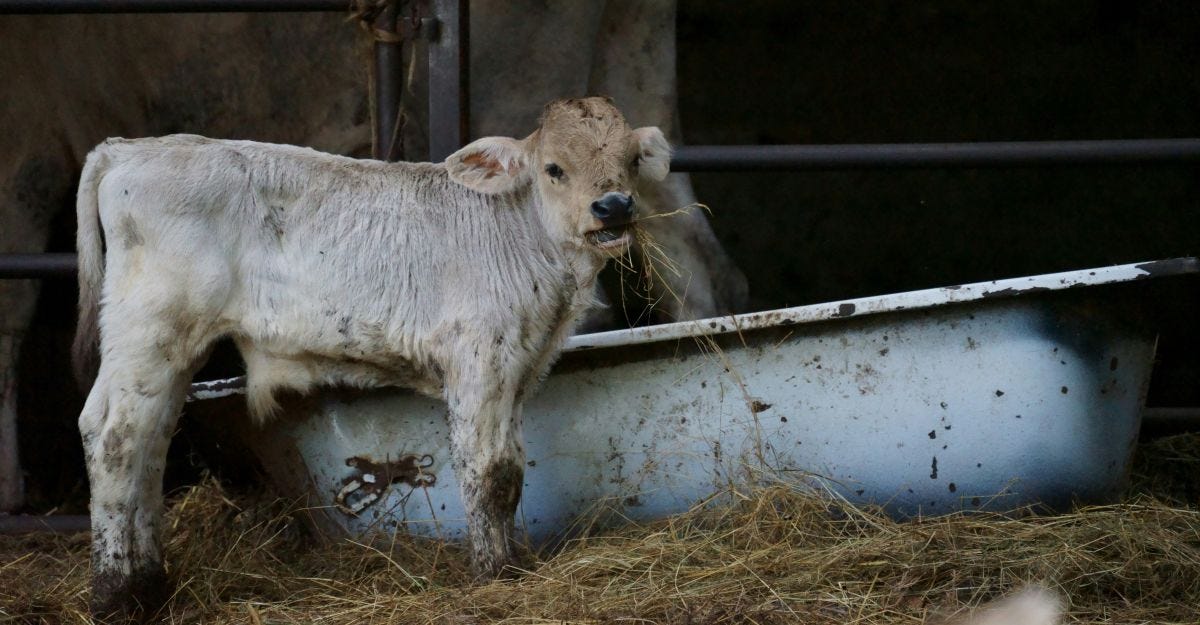
The shots didn’t ring out with that metallic rebound. There were only two, they came after dark and they were muffled, as if they hit their mark at point blank, if not direct contact. Then she began “signalling” — each time five calls, over the subsequent days and all at the same pitch: C above middle, dropping in tone ever so slightly at the end, like a sigh, tailing into minor.
Beethoven reserved C minor for his darkest music. His fifth symphony, with its opening motif, also repeating notes, invokes fate knocking at the door. His stormy Pathétique sonata and the profound resignation of his funeral march (the second movement of his third symphony) are devastating beyond words.
C minor rings out mournfully across the dairy plains of central northern Tasmania in the cool night air, in the feathery dawn light, in the buttery low-angled afternoon sun. On the calving season we arrived, there was nowhere for the calves to be “processed”. The abattoir at Cressy had been filmed by the animal activist group Farm Transparency Project and challenged for cruelty. The footage was described by a government taskforce as “horrific”, and the abattoir was shut down. Tiny bobby calves — that is, male calves less than thirty days old who are separated from their mothers — thronged the dairy plains of northern Tasmania. Little black dots huddled over the fields, folded over their still wonky knees in the lush grass, awaiting a sobering fate.
Given the intimate relationship we humans have with bovine creatures — for what can be more familiar than ingesting the flesh and bodily fluids of another being — it is surprising that until recently nothing on the World Wide Web could explain to us the meaning of cow calls. All I could find was an amusing compilation of their grunts, snuffs and splutters, but nothing that made any attempt to decipher them.
That has changed with research from the Netherlands by Leonie Cornips advocating for “an “animal turn” in sociolinguistics.” Cornips analyses the social interactions of dairy cows with themselves and their human owners through their vocalisations, which then guides training packages from the organisations Animal Union and Cow Signals for farmers wanting to optimise lactation. The two seem a little at odds. Can cows unionise and if they could wouldn’t they demand their lives before better payment and conditions? Meanwhile, it seems, understanding cow vocalisations is only in service to extract more from their bodies.
Back home, the cows file resignedly across the fields before the farmers’ chugging tractors, distended udders swinging as they herd in to be milked. This calving season, the bobby calves aren’t lingering in the paddocks for as long. As a result of last year’s delayed season, dairy farmers were left to euthanise their bobby calves themselves. The grim underbelly of the production of milk and cheese — I confess: staples to my own diet — is carefully concealed from public sight, putting it back on the farmers to manage this “by product” of dairy production, which, at the time, garnered them some media sympathy in national mastheads.
Bobby calves are removed from their mothers between the ages of one and thirty days and sent to market. Some are raised for veal, but in Australia alone between between 200,000 and 500,000 are killed annually. There has been a shift among dairy farmers, who now breed their cows with beef bulls so their offspring can be sold for meat when they’re at least a few years old. Bobby calving isn’t standard practice elsewhere: Professor Cornips tells me that “the figures of killed calves from a Dutch perspective are incomprehensible.” Dairy Australia recommends early separation, within twenty-four hours from birth, to alleviate the stress of grief for mother and calf.
Animals Australia, on the other hand, says there have been documented instances of cows chasing the trailers carrying their calves away. They write:
dairy cows are kept almost continually impregnated. Each year, she is forced once again to go through the physical demands of pregnancy and calving only to once again face the stress of having her newborn calf taken away — all to enable her continued milk production.
Often induced, dairy cows now produce more than double the milk they produced forty years ago — twenty-eight litres a day on average, to be exact. Their lifespan would, undisturbed, reach twenty years, but on average they are sold for meat between the ages of four and seven. The disconnect between bringing sentient babies blinking into the world to siphon off the milk that their short lives produce depends on keeping their fate hidden. No wonder Joaquin Phoenix called it out at the Oscars.
“Livestock is deadstock,” said a goat herder my partner and I met through Marketplace, north of the plains, in Forth. As we lugged their bookselves out and nested them into our blanket-lined trailer, her husband added: “there’s not a lot of room for sentimentality in farming.” When they moved from WA to Tasmania, twenty years ago, the couple shipped their goats with them, and mollycoddled a generation as they died out one by one. “We’re softies,” she explained, asking whether we’ll be running stock on our block. “I’m a huge sook,” I replied. But I can afford to be. I have another livelihood and my neighbours make their living as dairy farmers. Nestled among, watching them chugging over the paddocks at first light, on early dashes to the airport, their new and daily visibility to me, as much as that of their herds, deepens the mire of bobby calving.
As it is for all of us living within capitalism, the imperative to generate a profit, we might call it the stricture of surplus, is present to so much of our day-to-day lives. We open our fridges and graze staples wrought from the terror exacted on barely matured creatures, some seventy billion annually worldwide. No doubt my human neighbours, people farming for a living at all hours while being squeezed by the duopoly of supermarket chains, are forced to make savings at every step of production.
I emailed Ashmore, a local dairy that feeds its cows seaweed to reduce their methane flatus, to ask if they bobby calve. They replied no, they proudly raise their calves with the mothers. Back on the mainland, I’d done the same with Barambah, who also assured me they don’t bobby calve, and there are brands such as Elgaar and How Now Dairy that are explicitly marketed around their rejection of bobby calving. They share the milk with the calves. They are asking dairy farmers to join them in this practice. But if dairy farmers can be subsidised against flood and drought, can’t they also against cruelty? That would depend on each of our choices, and making them as visible as animal activists have sought to make the practice of bobby calving.
This article first appeared in Overland Literary Magazine 7AUG25, https://overland.org.au/2025/08/latte-in-c-minor/